Pages

Showing posts with label Marvel. Show all posts

Wednesday, June 27, 2018

[Quora Answer] Tony Stark vs Bruce Wayne (Compare and Contrast)

I swear I occasionally write about things that aren't comic books. Trust me. It happens. Very, very rarely, but it does happen.

Some spoilers for Avengers: Infinity War ahead.

See more of my content on Quora.


Is Iron Man Now a More Depressing Character than Batman?

While Tony’s certainly lost a lot (his parents, his mentor figure, the closest thing he had to a son, etc), he still has had a much better support network than Batman tends to have. Tony’s closer to the remaining members of the Avengers than Batman tends to be to the Justice League, or even the Bat Family.
Now, as of Infinity War, you could make an argument either way. I think a lot of it will revolve around how Tony reacts to these losses. Typically, when Tony loses something, he attempts to fix things, not break things.
This could be pretty important, because Batman, as we’ve seen, tends to deal with loss by punching it away.


He’s got a lot more anger in his system than Tony’s really ever had (with the possible exception of that one scene in Civil War). While Batman focuses on destroying and intimidating the criminal element in Gotham, Tony tends to focus on building suits, designing drones, AI, armor, support equipment, what have you. Batman needs to take out his anger and guilt issues on the criminal element. Tony needs to atone for his mistakes by building something better.
With Spider-Man, we see this take another form. He essentially views Peter Parker as his next project, as well as a surrogate son. He wants to make Peter a better version of himself, so Peter won’t make the same mistake, but also so that Peter will be able to do the job better than Tony ever could.
Batman cannot rest as long as there is crime, because he feels he is needed. Tony is trying to create a world where he, himself, is no longer needed.
With Peter gone, Tony could very well sink into a mire of depression and misery.
Or.
He could try to fix things.
Build something better.
Make it so no one will ever have to go through what he just endured.
Batman’s character is, to a certain extent, based around pessimism. Batman can’t really win. Not finally. He can’t rest or retire. It’s heavily implied that Batman is a destructive force, not only to crime in Gotham, but to Bruce Wayne as well, and everyone he cares about. Because Batman is working out his anger and guilt on all the individual petty criminals in his path, as well as the supervillains. And each act of violence he commits tends to create or inspire a new antagonist. Most of Batman’s villains exist because of Batman’s own obsessions. He essentially creates his own monsters. And so the cycle continues.
While Tony has created his own fair share of monsters, I think he’s got a hopeful streak that Bruce never really had. He believes he can make something better, so long as he just keeps trying.
As long as he keeps trying in Avengers 4, I don’t think Tony will ever be quite as depressing as Batman. Because Batman knows he’s going to die alone, having either driven away or ruined the lives of the people that he cares about. But Iron Man truly believes he can fix anything.

Tuesday, June 26, 2018

[Quora Answer] Thanos on Xandar

Spoilers ahead...

Someone on Quora was asking how various Quorans would write a scene of Thanos's arrival on Xandar. Given that this involves writing, writing villains specifically, and Marvel, I figured this fit pretty perfectly in my wheelhouse.

Very minor spoilers for Avengers: Infinity War ahead, but this is how I would have handled such a scene.

See more of my content on Quora.

The Fall of Xandar

If such a thing had to be done (presumably as a Marvel one-shot), I’d do it from the perspective of an ordinary Xandarian on the ground. Have it open with Thanos’s ship having just appeared overhead. Panic in the streets. What remains of the Nova Corps fleet rushing to meet the enemy head-on, but the end is clear. Everyone knows those pilots won’t be coming back.
A PA drones in the background, echoing hauntingly through the streets, notifying residents not to panic, to retreat to their designated shelters in an orderly fashion, that the Nova Corps is prepared. The Nova Corps will save them.
No one listens. The PA fades further and further into the background the longer the film goes on. We see civilians fleeing in every direction. Even a few Nova Corps soldiers are joining them, looking terrified. Our POV character is rooted in place, staring up at the massive warship overhead. Just in time, we see Cull Obsidian kicking a Nova Corps tank away with a lazy push of his foot, seemingly unaffected by the blaster fire striking him repeatedly from all sides. He notices us. A Nova Corps fighter swings by overhead, distracting Cull Obsidian just long enough for our POV character to scramble away, but before the fighter can do anything, there is a flash of blue light as Proxima Midnight’s spear tears the fighter in half.
From our hiding place, we see Ebony Maw tearing open a set of heavy security doors from a distance, using only the power of his mind, as he gleefully announces to Xandar that the Savior of the Universe has come.
“Thanos is here, dear children! Worry not! For the Titan shall set you free!”
We get distracted by Nova Corps reinforcements arriving, but Corvus Glaive appears and makes short work of them, dispatching them with ruthless efficiency and ease. Once, he comes within inches of discovering our hiding spot, but he, too, has his attention drawn.
As we see Thanos emerging from the smoke. A terrified Nova Corpsman, just a kid, maybe a cadet, is clutching the orb, trying desperately to keep it from the Mad Titan’s grasp. The city around him is burning, and his uniform is in tatters. He must have barely escaped some sort of slaughter in the vault where the Orb was being kept. Only for Thanos to pursue him.
The Children of Thanos form up behind their leader. Corvus Glaive makes a move towards the Corpsman, but Thanos holds up a hand. His expression is soft, almost gentle. He moves slowly towards the kid.
“There now, child,” he says softly. “I don’t want to hurt you. All I want is the Orb.”
“You can’t have it! Y-you can’t! You…killed…”
“I want to save you, boy,” whispers Thanos, getting down on one knee to look the boy in the eye. “I want to save all of you.”
He reaches out, stretching forth his hand to take the Orb. For a second, it looks like the boy will relent and give it to him. But at the last second, the boy scrambles back, tears streaking down his face. He can’t back away far. There’s a wall behind him that impedes his progress. He’s trapped.
Thanos’s expression is one of regret. Mixed with respect.
“I understand,” says Thanos, reaching for the Orb. “You are a brave man.”
He crushes the boy’s head in his fist with hardly an effort, and the body crumples to the ground as Thanos scoops up the orb. As he turns, he sees us. But his expression remains soft.
“I want to save you all,” whispers Thanos. “And I promise you, I will. No matter the cost.”
As Thanos and the Children of Thanos vanish into the smoke, the camera zooms in on our terrified POV character, and pans around to show the scope of the destruction.
The screen slowly fades to black, taking all the background sound with it.
Only the endless loop of the PA remains.
“Please remain calm…The Nova Corps is on the way…the situation will be resolved soon…please remain calm…”

Friday, June 22, 2018

[Quora Answer] Vision's Powers in Infinity War

Another day, another Quora answer in place of an actual post. This one has some spoilers for Avengers: Infinity War, so read at your own risk.

Spoilers...

Seriously, don't even read the title if you haven't seen the movie.

See more of my content on Quora.

Why Do Vision's Powers Fluctuate in Infinity War?

I believe the in-universe answer is that Corvus Glaive’s…well…glaive, was designed to pierce anything. The glaive “disrupts my phasing” he says. Since Vision’s powers mostly revolve around “hardening” or “softening” his body, the glaive effectively makes the bulk of Vision’s abilities unreliable at best. He’s still got the space laser thing going for him, but that’s pretty much always had a slightcollateral damage issue.
In a crowded city, like at the beginning, he probably didn’t want to risk it, even at the cost of his own life, until it was absolutely necessary.
Most likely, Corvus’s attempts to remove the stone directly with his glaive interfered even with that. I’m guessing Thanos didn’t send Corvus specifically after Vision just because he thought it would be a fun match-up. Pretty much all the Children of Thanos have some sort of advantage during their initial showing. Maw can hold his own against Strange. Corvus can overpower Vision.
Towards the end of the movie, Vision seems like he still hasn’t fully recovered from Corvus’s attack on him. He acts like he’s injured pretty consistently. It’s also possible, too, that whatever Shuri was doing to attempt to remove the stone from him was also weakening him, as it effectively would involve slowly cutting off his access to the source of his powers.
The out-of-universe reason is that Vision and Wanda needed to be in danger, and Thanos and the Children of Thanos needed to seem like a credible threat. Hard to threaten a guy who can make himself intangible at will. So give Corvus the ability to cancel out that power.
Problem solved.

Thursday, June 21, 2018

[Quora Answer] Why Marvel's Films Do Better than DC's

I was pretty active on Quora a few weeks back, and I thought it might be fun to share a few of my answers here, starting with a question of "Why Marvel's Films Do Better Than DC's".

https://www.quora.com/profile/Joseph-Rose-33

Why Do Marvel's Films Do Better than DC's?

A couple reasons.
First, Marvel was working from a position of weakness, whereas DC has been working from a position of strength. At least as far as characters go. When the MCU started, they didn’t have the movie rights to any of their top-tier characters. What they had were the B- and C-listers (as far as popularity goes, at least…Cap will always be #1 for me). This is actually pretty similar to the position Marvel was in when they created the Avengers way back in the day. Rather than choosing to take their bestsellers and stick them on a team together (like DC did with the Justice League), Marvel chose to revitalize some of their less popular characters by teaming them up. It worked like a dream back in the day.
But anyway, back to the movies. Marvel knew they wouldn’t be able to bank on brand recognition alone. They had to think, they had to plan, they had to get it right on the first try. So that’s what they did.
DC, on the other hand, had all their characters. Especially the best ones. Superman, Wonder Woman, Batman. They had the rights to everyone. They had the brand recognition that Marvel could only dream about. This meant that when it came time to make each movie, they banked a lot more on “Everyone knows Superman!” than Marvel could. Look at it this way, if you’ve got a massive arsenal of nuclear weapons, you probably won’t feel a burning need to spend time lining up your shot before you push the big red button. But if all you’ve got is a bow and a handful of arrows, you’d better make sure you make your shots count.
The only thing they didn’t have was time. Marvel had beaten them to the punch with the whole “cinematic universe” idea, and now whatever DC did, they would get compared to Marvel. So they decided to distance themselves from Marvel tonally, with…mixed success, shall we say.
However, this created another problem. DC didn’t want to risk Marvel getting further ahead of them than they already were, so they rushed a few things. Whereas Marvel released The Avengers as the sixth movie in a series, DC only really had three movies leading up to Justice League (Suicide Squad was in there too, but didn’t really contribute much to the mix).
The other main issue is that Marvel hires fans. Kevin Feige won’t bring on a director or a writer if they don’t love the source material. Look at Winter Soldier. Look at how cool the Russo brothers clearly think Captain America is. And they give him a lot of moments to show it off. Look at how cool Favreau thinks Iron Man is. Or how much James Gunn cares about the Guardians. They love these characters and want to share that love with the audience. As a result, we love them too. Even more impressive is the fact that Marvel tends to hire up-and-coming directors who love comics. The Russos, for example, had hardly done anything big budget before Winter Soldier.
DC hires people with pedigree. Zack Snyder has done some visually impressive movies before, but he clearly doesn’t get Superman. In my personal opinion, I think Snyder doesn’t even like Superman, not because of his character, but because Snyder has a hard time with what Superman stands for. This becomes pretty evident in Batman v. Superman when everyone but Superman gets to tell the audience their side of the story. But that’s another conversation for another day.
Yet another reason is more deeply ingrained in the characters. There’s a meme that goes “DC heroes are gods trying to be men; Marvel heroes are men trying to be gods.” It’s pretty close to true. Your average member of the Justice League could probably take down most of the Avengers on their best day, but this cosmic level of power tends to make DC heroes a bit harder to relate to. Effectively, DC tends to go for the power fantasy route (even Batman and Catwoman can somehow take out three Flashes at the same time nowadays), while Marvel tends to make more down-to-earth heroes (the “anyone can be a hero” route). This is a lot of the reason why DC’s big three (Superman, Batman, Wonder Woman) are two godlike immortals and one supergenius, while Marvel’s main heroes (Captain America, Thor, Iron Man, Spidey) are three mortals (one scrawny kid turned Super Soldier, one messed up recovering alcoholic supergenius, and a kid from Queens who got bit by a spider) and one godlike immortal. As a result, it’s slightly easier for Marvel to get us to relate to these characters on the big screen. I have friends who still have a hard time relating to Wonder Woman or Superman, even after seeing the movies.
Another reason is the visual effects (this is a tiny one, but it contributes). Marvel is owned by Disney, and Disney owned Industrial Light and Magic, one of the best visual effects companies in the world. As a result, Marvel and Disney get first dibs on ILM, and it shows. DC, unfortunately, tends to have to find someone else to be their main VFX company.
But the main reason, the #1 reason for Marvel finding greater success than DC…
Is this guy.
Kevin Feige. Perhaps the greatest superhero of them all.
If the MCU were a TV show, Feige would be the showrunner, the lead writer, the head honcho. He created a plan for the MCU early on (most likely he planned out Phase 1 by itself, with a few dangling plot threads, and then planned phases 2 and 3 together), and Marvel gave him the power to enforce that plan. Various directors have mentioned that Marvel gives them 2 or 3 mandates (this event needs to happen, this character needs to be introduced, this character absolutely cannot die, etc). These mandates all come from Feige. From his plan for the universe. And on top of everything else he does, he hires people who get along, so that James Gunn can work with the Russo Brothers just fine, without egos getting in the way.
After Infinity War, people are still finding bits of foreshadowing in previous Marvel movies (especially Age of Ultron). While some of this is probably the usual comics thing of one writer leaving a hint of things to come, and the next trying desperately to work out a plot that fits that hint later, but a lot of this is definitely Feige. He’s a master planner, and he’s a superfan to boot.
DC doesn’t have anyone to match Feige. Snyder was their best bet, initially, but we know how that turned out. And, later in his run, DC lost faith in Snyder and started undercutting him (again, with mixed results). Marvel has pretty much always backed Feige 100%.

Monday, May 7, 2018

Avengers: Infinity War - How to Kill Your Characters

So I saw Avengers: Infinity War a week ago, and just had a few quick thoughts. In short, it's awesome, but I find it's harder to learn good lessons from good movies. Generally, you just learn how to do what that movie (or book) already did. Still, there are a couple things that Infinity War helped me put into words, so here we go.

Now, I'm hoping most people will have seen the movie by the time this goes live, but just in case...

Y'all have been warned
Killing characters seems to be the latest writing trend. After Game of Thrones, it seems to be understood that, if you don't kill off at least one character in your story, you're doing something wrong. This has also led to a general belief that if you want to raise the stakes or take your story in a more serious direction, killing off your characters is the best way to do it.

Now, for full disclosure, I kill off a fair number of my characters too. It's one of the first things I work out, you know: what's the beginning, what's the ending, who are the characters, and how many of them die, that sort of thing. So, you'd probably think that I'm a fan of this trend.

Not really, actually. It started out pretty well, with more and more writers taking a few pages from the Joss Whedon book of murder (still not over Wash, by the way), but recently I feel like writers have been going a bit overboard.

See, I think that killing characters is sort like the nuclear option. Sure, it's shocking. Sure, there are situations when it's necessary. And, when you do use it, it makes for a cool story, but only if you do it right, and put a lot of thought into why you're doing it. Because, let's face it, a character death that results from the writers seemingly pulling a name out of a hat, it feels really, really cheap and unsatisfying. It might be shocking in the short term, but long term, it doesn't sit right.

I used to think that the best way around this was to have each character death be some sort of noble sacrifice, but that didn't quite fit either. Some character deaths stick with us and have meaning, even if it's just a random murder. The death of Maes Hughes in Fullmetal Alchemist: Brotherhood is heartbreaking, but doesn't feel cheap, because, even if he didn't sacrifice himself, his death still means something. And without his death, the plot couldn't move forward at all.

Avengers: Infinity War very much subscribes to this methodology when it comes to killing characters. None of them are the result of a sacrifice that leads to the villain's downfall. All of them, however, are the result of Thanos having them outsmarted, and outgunned. And all of them are the conclusion of a character's arc, and serve to drive the plot forward.


By having the movie open with Thanos brutally murdering Heimdall and Loki (with Loki arguably being one of the most popular characters in the MCU), Infinity War establishes the stakes. No one is safe anymore. The characters even point out that Loki won't be coming back multiple times. But each of them gets something to do, some point where they can make a choice and take a stand. Heimdall has been largely ignored, but he draws attention to himself by using the last of his power to open the Bifrost and sent Bruce Banner to safety. And Thanos kills him for it. Loki can talk his way out of just about anything, and while Thanos clearly doesn't trust him, it seems as though Loki could talk his way out of this one as well. All he needs to do is stand by and give Thanos the Tesseract. Instead, he takes a stand, making a desperate play to assassinate the Mad Titan. And Thanos kills him for it. For both Heimdall and Loki, their deaths had meaning, and the plot was planned around that. Heimdall has always done what he perceived to be his duty, and in that moment his duty was to help Banner escape and warn the Avengers of what was coming for them. That sense of duty leads to his death. Loki has always been a trickster, but Thor has always maintained that there was a better man inside him. He proved it in Thor: Ragnarok and he proved it again here. His last act of defiance, his willingness to endanger himself to protect his brother, is the conclusion of his character arc. Without Heimdall, the Avengers wouldn't know what was coming for them until it was too late. Without Loki's sacrifice, Thor might never truly know whether that better man was just a part of his imagination. Both of these deaths not only drive the plot, but also serve as Thor's motivation to take down Thanos once and for all.

Later in the movie, we get our third character death, when Thanos is told that the Soul Stone can only be obtained by someone willing to sacrifice what is most important to him. Gamora's expression is one of vindication. The universe, she thinks, has finally played its last trick on Thanos. His plans have fallen into ruin, because she knows he can't care about anything. But she never expected how much he cared about her, in his own twisted way. Without Gamora, Thanos would never obtain the Soul Stone. But more importantly, this is a conclusion to Gamora's arc as well. We've been told constantly how Gamora is the favored daughter of Thanos, how he treated her much better than Nebula, how he hoped that she would sit in his throne one day. Her death serves not only to define their relationship once and for all, but also to define Thanos, and to show us that the Mad Titan is not just some conqueror or tyrant. He legitimately believes he is the hero of his own story. He really believes he is saving the world. But the world cannot be saved without sacrifice. And this is what Thanos must sacrifice. In a way, this is the part of the movie where Thanos proves that he is actually the protagonist of Infinity War, even if he is the villain. More than any other character, he willingly gives up what is most important to him in order to save the world.

But Gamora's death is also the result of her own choices. She rashly attempts to kill Thanos on Knowhere in spite of Star-Lord's objections, which leads to her capture. When Thanos is torturing Nebula, she willingly gives up the location of the Soul Stone in an attempt to stop him. When he tries to tell her how much he cares about her, she refuses to listen. When he tells her to take him to the stone, she goes. When Thanos is told what he must sacrifice, she spends time lording his failure over him, rather than making any attempt to escape, because she refused to see what the audience knew all along. That what Thanos held most dear to him, was her.

At first, Vision's death looks to be the sacrifice play we had been waiting for the whole movie. Until Thanos uses the Time Stone to undo his sacrifice entirely, and takes the Mind Stone by force, killing Vision a second time. Vision attempted to sacrifice himself for humanity, and though that sacrifice ultimately failed, it was not without meaning. Because Vision's death, like the others, is the conclusion of his arc. In that moment, he embraced what a hero needed to do, and he did what he needed to do to protect the woman he loved. Vision, an AI given a vibranium-laced body, capable of phasing through any danger or blasting anything dangerous with the Mind Stone from a distance, has never truly had to face the idea of death before. But he willingly accepts it here, in an attempt to foil Thanos once and for all and protect what's dear to him. Though his sacrifice failed to stop Thanos's master plan, his death was still a noble one.

Anyway, those are some of my thoughts on writing and on character deaths in particular. Let me know if you have any thoughts about this one!

Monday, April 30, 2018

The Problem with Logan

With the release of Avengers: Infinity War, there's only one Marvel movie anyone's writing about. Fortunately, I have my finger quite firmly on the pulse of the people, so I'll be writing about a movie that was released by a completely different studio over a year ago.


I'm so timely.

I saw this with a couple friends back when Logan first came out (back in ye olden days of 2017), and I have to tell you, I had high expectations. The first trailer (you know the one, the one with Hurt by Johnny Cash playing in the background) got me excited beyond all reason, and I'd read the Old Man Logan comics the movie was based on, and absolutely loved them. The worn-down, almost pacifist version of Logan, haunted by his past mistakes even more than usual, the country life and small family keeping him down to earth, while also giving him something to lose, the bleak post-apocalyptic landscape, the road trip structure where Logan and Clint encounter supervillain after supervillain one at a time, the Logan vs Red Skull fight, and the whole finale...basically, the original Old Man Logan is one of my favorite comic miniseries. I love just about everything about it.

Now, I knew Logan was going to be pretty different from the comics by necessity. When the two main antagonists, the Hulk and Red Skull, are owned by another studio, you've obviously got to make some pretty big changes to make the movie work. Plus, the whole "cross country road-trip" thing worked much better as an episodic miniseries than it would as a movie. But when that first trailer came out, any potential worries I might have had for the movie went right out the window.

One of my friends sent me an email right after the trailer dropped.

"So...is this basically The Last of Us: The Movie, but starring Wolverine?" he asked.

I rewatched the trailer. Old, embittered man with graying hair and a beard making his way across the American countryside, protecting a girl that holds the key to the future, growing closer to her over time, and savagely murdering any survivors and soldiers who would dare lay a finger on her. Yup, that was basically The Last of Us, but with Joel swapped out for Wolverine and Ellie replaced with Laura. Add the presence of a guitar strumming mournfully in the background, and the trailers were even similar.

"Yeah," I said.

"Dude, that's awesome!"
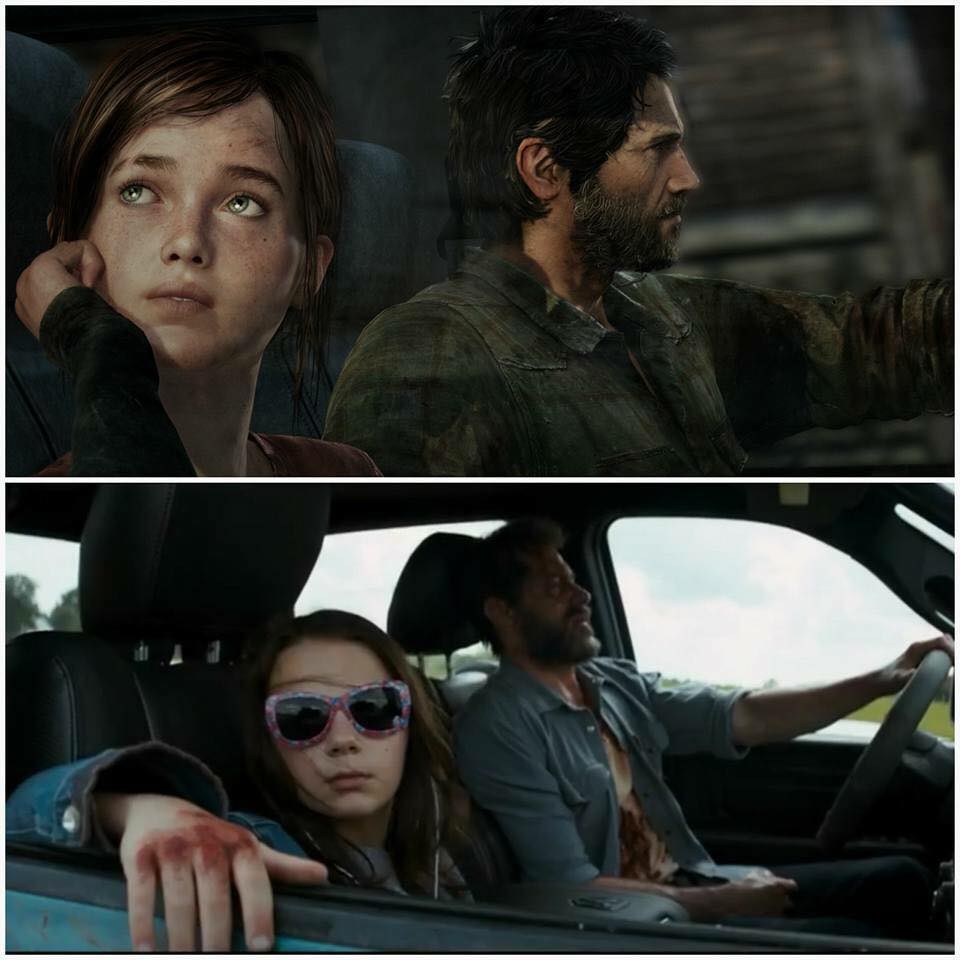
The Logan of Us, coming soon to Playstation Theaters...
They'd clearly put a lot of effort into pointing out similarities between their plot and characters and those of The Last of Us. And, honestly, no one I knew minded. Wolverine fits the Joel mold so well that I started to wonder if Joel was supposed to be based on Hugh Jackman's interpretation of Wolverine from the very beginning. When you stop to think about it, the basic ideas behind The Last of Us fit with the ideas and themes from Old Man Logan: road-trip through a post apocalyptic America, a vague suspicion of everyone you meet, a world-weary but savage protagonist fighting for what little remains of his family, the problem of saving the world conflicting with saving what you love, if it's even possible at all. The trailer, partly through this comparison, but also just through its imagery and structure, conveyed a very clear idea: Logan is going to be in the dumps at the beginning, he's going to take Laura under his wing at Xavier's behest, he'll eventually grow close to her, and when the bad guys come for her, we'll get to see Wolverine at his most brutal. Plus, now it's rated R so brutality ahoy!

So as we were sitting in the theater, waiting for the movie to start, we were getting pretty excited. Once the movie got going, however, a couple problems surfaced. The opening scenes were all right, and did a good job of setting the tone, but one of them in particular set off some alarms in the back of my head. There's a scene of Logan driving various people around, and all of these people suck, and you really feel for Logan here, but one of them features these random girls on their way to a party, and one of them randomly flashes the camera. It's pointless, it adds nothing to the movie. This isn't a nudity movie. In fact, after this one gratuitous scene, there will be exactly no nudity for the rest of the movie (Hugh Jackman doesn't even take off his shirt that often). Literally all this does is say "Hey everyone, this is an R-rated movie, look what we can do." And that isn't good filmmaking. That's a wasted scene. It took me out of the world, it made everyone in the theater go "What?" very audibly. And I get that you want to make it clear that this movie is rated R, but a) the first action scene did that just fine, and b) there's an action scene in 15 minutes where a 12-year old girl decapitates a grown man on screen and then proceeds to do the same thing to about five other guys in 20 seconds.

Seriously, this girl kills at least 20 men over the course of the film.
...
And I love it.
That does a pretty good job of saying "we're R-rated now, so we don't have to hold back", it establishes Laura as a badass after Logan's own heart, AND it fits the movie. So if it wasn't to establish the tone of the movie, introduce an important character (the girls never come back), or introduce a future plot point...what's the point of that scene? Other than to revel in what R-rated flicks can get away with. Which a) isn't good filmmaking, and b) reveals a certain lack of focus on the director's part. Which continues to cause problems down the line.

Logan's healing factor is slowing down, you see, which is why he can age and has scars now. On its own, this isn't a bad idea, even if it's almost the exact plot of The Wolverine. Logan's vulnerable now (again), and he can theoretically even be killed, in spite of his adamantium skeleton. The problem lies in the execution of this idea. In The Wolverine, a scientist ran an experiment on Logan to halt his healing factor; this was a very smart, very rich man who spent his entire life working out how to do exactly that. In Logan, the reason for his regeneration slowing is...adamantium poisoning. Apparently his adamantium skeleton has been slowing his regeneration all along, but nobody noticed for 50 years (Logan is set in 2029, while X-Men Origins: Wolverine has him get his adamantium bones on or before 1979). Also the future timeline of Days of Future Past takes place in 2023, and he had barely aged at all, and showed no signs of being poisoned or not healing as quickly, so I guess it requires over 45 years of buildup before there are any visible affects. Also adamantium is a metal, and isn't even a little radioactive, so there's no reason for it to poison him unless his body is rejecting it (which would have happened 50 years ago) or unless bits of it are flaking off somehow (but adamantium is unbreakable). So...yeah...that didn't make a lot of sense. It was suitably tragic, but it didn't fit with anything else.

There's also a plotline where they mention that mutants aren't being born anymore. But the eventual explanation is that the government was putting drugs in the corn and in the water to target the mutant gene. This is basically delivered by the villain (I refuse to refer to him by any other name than Darwin Mayflower, since he's literally still playing the same role as he did in Hudson Hawk) as a quick aside, over the course of maybe one line. Other than that, it doesn't affect much, and it's never dealt with afterwards. Apparently the secret to stopping the mutant menace wasn't Sentinels, it was corn. Who knew?

Maybe the GMO corn and the cloning labs were based on
lost Da Vinci inventions?
Still, the "mutants are dying" plotline serves as little more than a cool line for the trailer and some pointless world building, which this movie has a lot of. There's a scene where Logan helps out some random farmers, and spends maybe 15 or 20 minutes hearing about all their troubles and woes, only for them to be brutally murdered 5 minutes later (apparently stopping to spend the night at a defenseless farm when hardened killers are chasing you is a bad idea, which Logan even acknowledges before he...does it anyway). There's also about 5 minutes devoted to these driverless trucks that have taken the place of our current delivery trucks. One of them malfunctions and nearly hits our heroes, and that's the last we see of them. Yup. Really essential to have a scene with driverless trucks going through this...really, really rural countryside when literally no other vehicles in the movie are driverless. That added a lot to the plot. I mean, it's a cool idea, and might even be a thing in a few years, but in a movie like this it's just one more bit of world building that contributes nothing to the plot and, given how much like a western this movie feels...it seems really out of place. I mean, it works as an idea in I, Robot because omnipresent automation (and the dangers it presents) is one of the main themes (a theme that's reinforced when vehicles on auto-pilot start trying to kill Will Smith). Here it's mostly just a throwaway scene. There's also a running plotline of Canada being a safe haven for mutants, which everyone seems to agree is probably true, even when it's eventually implied that there is no safe haven for mutants. At which point, everyone's goal is still to get to Canada.

There's also a scene with Xavier, to indicate his mental illness, where he just starts spouting nonsense, and Patrick Stewart sells this scene, but his string of nonsense ends, and I kid you not, with text lifted from a Taco Bell commercial for the quesalupa. The director, James Mangold, has even admitted that he couldn't think of what else to write, so he just lifted a quesalupa commercial and stuck it into the movie (Taco Bell had sent him the commercial because they were looking to advertise in the movie, but he apparently never agreed to the deal and never took their money...while advertising for Taco Bell anyway). Again, this movie is set in the future, with driverless trucks and clones and cybernetic limbs, where the adventures of Logan and the X-Men are so far in the past that they've become little more than legends (and comic book characters, in my personal favorite easter egg, even if it was lifted right out of Captain America: The First Avenger), and Xavier makes a reference to a 2010s Taco Bell menu item. It takes you out of the world (it certainly took me out of the world), it adds nothing to the plot, and just indicates that the director wasn't sure what he was doing with that scene.

Out of ideas for meaningful dialogue? Taco Bell's got you covered.
Most of the stuff immediately after this scene is pretty good. They develop a fun family dynamic between Logan, Laura, and Xavier, with Xavier being the crazy grandpa, Laura the semi-psychotic daughter (especially relevant since she's technically Logan's clone), and Logan the exasperated father trying to keep both of them out of trouble. During these scenes, Logan and Laura have a fun dynamic, where Logan's trying to be as good an influence as he can, while still being himself, resulting in a scene where he stops her from shoplifting and attacking a random cashier, then apologizes to the guy and steals from the store anyway.

Where things really start to go awry is around the middle of the movie. Xavier is dead, and the bad guys are just about to reveal their secret weapon. Now they've hyped this superweapon of theirs throughout the entire movie. They don't need to take care of the genetic offspring of older mutants anymore, they don't need to make an army out of them, like they originally planned. After all, they have this superweapon. And when they finally reveal it...

And it's another Wolverine. It's exactly like our Wolverine in every way, except they grew it in a vat (nevermind that cloning doesn't work like that, and that the movie even admits cloning doesn't work like that, which is why Laura is a child). So he's actually stronger than our Wolverine because his adamantium poisoning still has 40+ years before it starts having any effects. And you know this Wolverine is pure evil because he has a darker shirt (my guess is there was the script for Superman III sitting next to that quesalupa commercial when Mangold was out of ideas). Apparently the whole "brainwash children into becoming perfect mutant soldiers" thing didn't work out (no joke, they actually forgot the brainwashing part, which might have explained why literally none of these future child soldiers are even remotely obedient), so they decided to create a fully grown clone of a man known for his berserker rage and savage bloodlust and try to control him instead. Yeah, let me know how that works out for you.
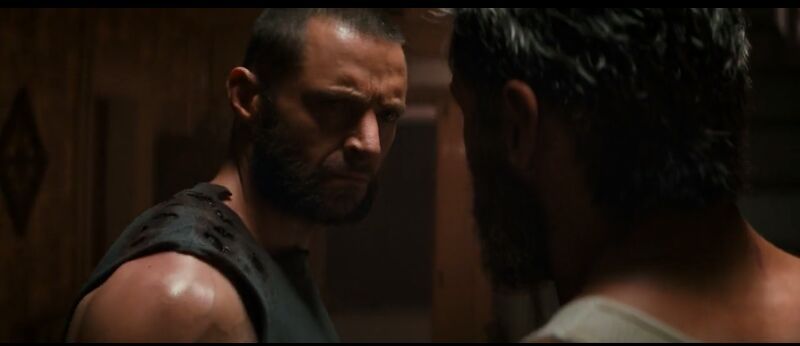
First they came for the quesalupa commercials, and we said nothing. Then
they came for the plot of Superman III, and still we said nothing.
I guess filmmakers still haven't realized that having two identical people punching each other in a dark environment is confusing, so here we go. Fortunately, this is Logan, so you can always work out which one's the evil clone by looking for whoever is currently winning. Because it certainly won't be Logan. 

This begins the part of the movie where Logan is, quite frankly, useless. He gets the crap kicked out of him by his Mirror Universe double (look he even did the Mirror Universe thing of having different facial hair), he gets dragged along the last part of the way by Laura, he gets saved by a bunch of kids (mutant child soldiers, yes, but kids nonetheless), and so on. The kids figure out a way to temporarily fix his regeneration (that's convenient). The kids all come up with a plan, and Logan just sits there. He doesn't say "Look, I'm the adult here, so here's what we're doing". He just kind of lets them do their own thing. Even in the climactic battle, he kills a couple mooks, but none of the named baddies. The kids take all the actual villains out, while New Jackman starts kicking the teeth out of Jackman Classic. One of the named villains gets taken out by a cluster of kids that we have spent, at most, 10 minutes with. So there's no real emotional payoff. We don't care about these kids. We haven't had time to. We do care about Logan (who gets his butt kicked) and Laura (who does all the actual work). 

Now, in fairness, the start of the battle has Logan effectively supercharging his healing factor using the healing potions the kids conveniently brought along, which leads to a scene where he's going on a rampage through the woods, killing all of the half-dozen soldiers in his path. He does this because the bad guys have set a trap for the kids (after Logan let the kids and Laura leave on their own). But he doesn't really do much to alter the tide of battle here, as Laura and the kids are more than well-equipped to handle these soldiers. While there is a moment where things look bad for Laura, she's faced worse odds earlier in the movie, so she could clearly handle things here.

But clearly there's an inverse ninja law thing going on here, because Logan's super healing potion runs out as soon as he's done dealing with mooks and has to face named villains. He winds up getting savagely mauled by Newverine while the kids deal with everyone else, and then Laura manages to take out Clone-Logan (Clogan, if you will). There's a heartfelt farewell scene between Logan and Laura, and then he just basically bleeds out and dies. Then they have a funeral for him and Laura takes the cross one of the kids set up and turns it to look like an X. 

Get it? It's an X. Because he was in the X-Men. Get it guys?
What do you mean literally everyone saw that coming?

(For more on why the X-grave maker is a bad idea, see this article, which also has a much more positive outlook on the movie and discusses a lot of its overarching themes)

And that's basically it. That's the movie.

So, like I said, the movie's pretty good. It just doesn't go all the way to great. Sloppy world building and some moments of unfocused directing don't help, but they're not the big downside here. The main problem with Logan is the relationship between Logan and Laura. While Xavier's around, it's pretty good, solid character work. Dad-Logan is fun to watch. But once Xavier dies that just sort of goes away. They still have one or two moments, but they're mostly moments of Logan not wanting to do any of this and Laura having to either do it for him, or cajole him into doing it. They start off the "Man begrudgingly takes in orphan, slowly develops feelings for her, and then becomes a surrogate father" thing, but they don't really develop it much, until the very end of the movie where they basically clap their hands and say "Yup, and that's the end of their arc. They're father and daughter now. Setup be darned."

But a lot of the problem, too, is that, after the fight at the beginning of the movie, Logan doesn't really...do much. He mostly complains about things and gets his butt handed to him. And I don't know about you, but I go to see Wolverine in movies to see him tear through mooks like paper and go toe-to-toe with savage and seemingly unbeatable foes and come out on top. We want Wolverine to feel powerful and brutal. And Old Man Logan showed that you could still have an old, weary Logan feel like a badass. But all the best action scenes involve someone who isn't Logan. He has two brief moments of world-weary toughness at the very beginning and end of the movie, but he doesn't really drive the plot. He doesn't move the plot at all, actually. He just reacts to it. It isn't until the very end of the movie that Logan makes a meaningful decision that affects the plot, and it's a decision that he honestly should have made earlier, but didn't because they needed to pad out the running time a bit.

Again, Logan is a good movie. But it's far from the best Marvel movie of all time. It's not even the best X-Men movie, and if The Wolverine didn't have that stupid boss fight at the end, it wouldn't even be the best Wolverine movie. There are some great character moments, but also some wasted ones. The villains are pretty forgettable and, aside from Hulkverine, aren't even much of a threat. They don't even have any real connection to Wolverine, other than having gotten some of his DNA at an unspecified point in the past.

There's also a lot of wasted characters. People show up and take up screentime, but don't really contribute anything to the plot. The farmers, for example, as well as Darwin Mayflower (who I'm sure has a different movie but he was so forgettable this was the only way I could remember him). Even the tough-looking dude with the robot arm (Pierce, I think his name was) doesn't really do much to establish himself as a threat. Maybe if they had made him the clone of Wolverine (but slowly grown in a vat over 30 years or something), and had that as the big reveal, maybe that would have been a bit better. Or maybe if, instead of a Wolverine clone, the big monster had turned out to be some cybernetically enhanced, roided-out version of the Juggernaut, or something more interesting than "It's Wolverine but evil this time".

Basically, Logan is a good movie that fell well below the expectations set by its trailer (Logan doesn't make too many people hurt in this movie, to be honest), and mired by some clumsy screenplay and directorial decisions. As with a lot of more recent movies (looking at you, Moana) the problems start in the middle, and by the time the movie is past them, it doesn't have enough time to fix those problems and finish up the movie. All the acting, however, is top notch. The music is great, and the fights are brutal and gory enough to almost satisfy any Wolverine fan who felt that the X-Men movies had sanitized him too much. If only he'd gotten more time to be badass, and if they'd focused a bit more on actually developing his relationship with Laura, it could have been a great movie and a truly worthy sendoff to Hugh Jackman's Wolverine.

I shall leave you all with the famous words from the man himself...
Deal with it, bub.