I'm a big fan of open world RPGs. I've honestly put an unhealthy amount of time into games like Skyrim, Dragon's Dogma, Fallout, Dragon Age, and the like. So it shouldn't come as a surprise when I say that The Witcher 3: The Wild Hunt is awesome. Seriously, it does an awesome job of creating a wide open world for you to explore, and all of it manages to put you into the head of Geralt of Rivia, our two-sword-wearing, white haired, gravelly voiced, oddly American-sounding protagonist. Since a lot of the world building comes almost directly from the novels (and I'm a huge fan of world building), I thought I'd give the books a read.
Spoilers below, by the way.
Written by Polish author Andrzej Sapkowski, each book in the Witcher series touts various reviews by lofty publications, all stating how these books are a breath of fresh air, and that they bring something new to the genre. Which I'm down for. I'd read up on various interviews with the author too (please don't ask me to type his full name again, it was hard enough the first time), just to get a feel for him. He talked about how important it was to have Geralt be neutral, even during a time of political upheaval, to always give the reader a limited perspective on these various world-ending events, but an unbiased one. Which, again, I'm down for. And after enjoying The Witcher 3 as much as I did, I was really looking forward to seeing how Sapkowski would pull this off in novel form.
To start with, the books actually have a lot of interesting ideas, and the short story collections (The Last Wish and The Sword of Destiny) are actually really cool at points. Very rarely does Geralt go up against a cackling, mustache-twirling baddie. For the most part, the monsters he fights are intelligent, sometimes bordering on sympathetic, and either just doing what's in their nature (vampires drinking blood, for example) or doing what they need to do to survive (literally any storyline featuring the elves). In my favorite Witcher short story, "The Lesser Evil", Geralt actually sympathizes with the antagonist more than he does with the person he's trying to protect (side note: never trust wizards that seclude themselves in towers for years at a time conducting experiments).
The Witcher games (the good ones, I mean; namely 2 and 3) tend to follow this trend. Most of Geralt's allies are noble, but very flawed (King Foltest comes to mind). Some of them are villains that Geralt is forced to work with to survive. And sometimes even the most tyrannical lord can turn out to be a pretty nice guy once you get to know him. Which, in my opinion, makes the world feel very interesting.
The novels though, largely drop this idea. We're shown a lot of schemers, such as the Sorceresses' Lodge, but we're never given any information on them, other than "these people scheme a lot". The villains that show up practically twirl their mustaches at every opportunity (see pretty much every antagonist in The Tower of Swallows), and a lot of the characters we're supposed to sympathize with don't really have any redeeming characteristics. Some characters have unclear and often seemingly contradictory motivations. In the books, Triss Merigold (my favorite character from the games) seems largely to exist to serve the plot, even going as far as to drag all the characters, kicking and screaming, into the story for the first novel.
 |
| Triss's main contribution to the novels is to teach Ciri how to apply makeup and then just kinda stand there. In the games, though... |
And nowhere is this more apparent than in the series' secondary protagonist: Ciri.
Ciri's character seems to change pretty drastically, depending on where she is and what the author needs her to do. In Time of Contempt, Ciri is tempted by, well, magic itself (long story) to accept her destiny and plunge the world into chaos, kickstarting the end times. She isn't aware of the full extent of her destiny, but she knows giving in would kill a lot of people, so she actually sacrifices her ability to use magic to make sure that she never gives in to that temptation. Earlier in that same book, she risks her life (and draws the attention of powerful beings, both evil and benign) to protect a bunch of innocent people from a monster. Fast-forward to book 3, Baptism of Fire, and she's fallen in with a bunch of bandits who call themselves The Rats (who, in all fairness, did save her life), one of which tries to rape her (but she doesn't hold a grudge I guess?), and another of which takes advantage of her when she's emotionally vulnerable (again, no grudges held, and no judgment passed). Oh yeah, and they raid villages and kill people. Because they're bored and want to be free.
So yeah, Ciri goes from wanting to protect others to killing and robbing them because she feels like it. In one book. And in book 4, The Tower of Swallows, Sapkowski resets her again, and she suddenly doesn't want to kill people anymore.
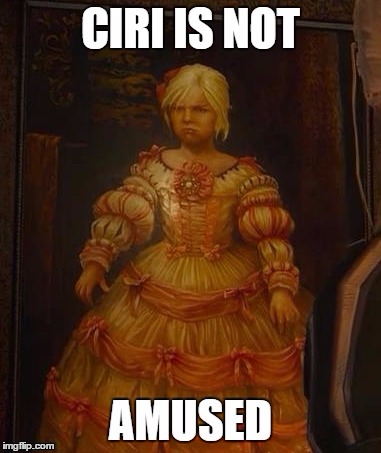 |
| All she wants is to be written consistently...is that too much to ask? |
Speaking of which, Ciri isn't the only female character to get reset. In fact, it really only seems to be the male characters that act consistently. At one point, a female scout named Milva discovers she's pregnant. But she's on a mission to help Geralt rescue Ciri (even though she barely knows Geralt and has pretty much no idea who Ciri is, but hey, he's the main character, so everyone needs to find him attractive and help him accomplish his objectives, right?), so she keeps trying to help him and fight beside him anyway. Well, long story short, at the end of the third book, Milva loses her baby, and rather abruptly at that. After nearly half a book of setup, it seems like we should get an arc where Milva is doubting her own motivations and mourning her lost child.
Nope. We get a sum-up at the beginning of The Tower of Swallows, where we're told that Milva was sad for a while, but after a few weeks was her normal self again. And it's never brought up again. The only consequence of this whole arc is that this causes her to cut her hair, which factors into a later plot point.
I feel like there was an easier way to do that. Like, a lot of easier ways. Including "I cut my hair because I felt like it".
That whole arc also factors into another problem with the books: anachronisms. Sapkowski spends a lot of time and effort establishing the world of the Witcher. It's gritty, it's dirty, it's chaotic and brutal. You can easily see that he's going for the whole "The Middle Ages weren't really that great" aesthetic. Fair enough. As long as you stick by your guns on that one. Which, to be fair, he generally does. The peasants are superstitious and unlearned, certain religious leaders use supposedly holy texts to manipulate the masses, marriages are more about contracts and territory than they are about love, soldiers on both sides commit horrible atrocities, kings plot and scheme behind closed doors, spies are everywhere, and wars are as much about economic gain and ruthless pragmatism as they are about borders. It all feels very much like the middle ages. Or, at least, the way modern history books seem to portray the middle ages.
Well, until a bunch of mages start discussing feminism.
It's an odd trend in modern fantasy (especially of the "mature" variety), to mix and match medieval mindsets with decidedly modern ones. For Sapkowski, as with many modern writers, the disconnect comes whenever the narrative touches on one of today's hot button issues. As an example, Sapkowski's world is one where people believe in a diverse pantheon of gods, a world where magic is real, and yet he has a scene where a scholar puts down his opponents as "science deniers". There's also a scene where various character discuss their viewpoints on abortion (the scene, by the way, contributes nothing to the plot), all of which are very...shall we say...modern, all about a woman's right to choose.
For me, at least, this trend takes me out of the world, resulting in what I like to call "narrative whiplash". What makes this even worse is that most authors, including Sapkowski, seem to use moments like these pretty much exclusively to state their own political views, rather than to advance the story or develop the characters in the scene.
For me, at least, this trend takes me out of the world, resulting in what I like to call "narrative whiplash". What makes this even worse is that most authors, including Sapkowski, seem to use moments like these pretty much exclusively to state their own political views, rather than to advance the story or develop the characters in the scene.
I realize that this is a fantasy world, but you can't show the masses and the political leaders all having very medieval mindsets, living in a world that justifies those mindsets, and then have all the main characters act like they stepped out of 2017. And no one bats an eye.
As far as Sapkowski's writing goes, it's kind of hard to judge, since the novels were translated from Polish into English. There are some weird word choices (Geralt repeatedly using the words "Darn it" and having a favorite sword move called the "pirouette" are some good examples), but that's probably just poor translation.
But Sapkowski also has an odd tendency to experiment. Which isn't necessarily a bad thing, it just gets very distracting, very quickly. In the first novel, he tends to write various "training montages" as dialogue. Only dialogue. Without any he said/she said statements. Which sounds like an interesting idea at first, until you're about a page into one of these montages and realize you're not entirely sure of what just happened or who's speaking. And the fourth novel is written out of chronological order, with the narrative jumping forwards and backwards in time, seemingly at random and with no indication of where you're supposed to be in the timeline.
The plot is actually pretty simple. Ciri is the lost princess of a fallen nation. Various people want to control her so they can control her subjects. Ciri is also the subject of a prophecy about the end-times. Other people want her to: a) stop the end times, b) get the end times going, or c) experiment with eldritch forces from the dark beyond because what could possibly go wrong? Geralt doesn't want them to get her, but they get separated, so Geralt goes on a quest to find her.
There are a couple twists and turns here and there (somewhat undercut by lots of political discussions with people we don't know, but hey), but largely it's that simple. The books aren't political thrillers set in a fantasy world, like the Witcher 2 was. In tone and themes, they're probably closest to The Witcher 3, with Geralt wandering through a war-torn world in hopes of finding Ciri, but the characters he meets along the way, in the books, are nowhere near as complex or interesting as the ones in the game.
There's also less of a sense of agency in the books. Part of that, I'm sure, is a difference between what works in games and what works in books, but you still want your protagonist to have a fair amount of agency in their world. In the last two Witcher games, Geralt gets himself involved in some pretty huge events. He helps besiege a castle, gets accused of murdering a king, discovers several conspiracies, gets roped into a conspiracy to murder another king (for realsies this time), turns the tide in a gang war, decides the fate of dozens of mages, and helps determine the future of several nations, all while staying one step behind the Wild Hunt. He's not trying to do all this, mind you. He's just trying to get by and find Ciri. All those massive events are things he has to do to accomplish his goals.

In the books, though, Geralt has accomplished relatively little. He's taken part in a skirmish against a small band of elves, fought an assassin (who escaped), got into a fight with a mage (which he lost), helped save a deposed queen's life (which was actually fairly interesting), and is still no closer to locating Ciri. Don't get me wrong, it is somewhat interesting to see a protagonist just trying to keep his head down and survive in the midst of a brutal and chaotic war, but sometimes this makes Geralt seem like a passenger in his own story. Especially given the number of times he either a) does what other characters tell him to do, or b) gets overruled when he comes up with a plan.
For all my griping, there are aspects of the novels that I really like. When Geralt's on form and allowed to be as snarky and cynical as he likes, the results are both entertaining and hilarious. Triss trying to teach Ciri how to be more ladylike also has its moments, especially when Triss starts bossing all the Witchers around. The plot consistently manages to be unpredictable and interesting, even if it has a tendency to meander at times. The plight of the elves is also handled pretty well, and Sapkowski has an interesting spin on the whole "we are a dying people" trope. Sapkowski clearly struggles a bit with exposition and setup, but once he gets past that phase, he's clearly much more in his element. His incidental characters (primarily the male ones, since he definitely struggles when writing women) are generally quite interesting, with a cast of characters including a vampire who doesn't drink blood, an imperial who keeps insisting he's not an imperial, a bard who starts writing his heavily-embellished memoirs at the beginning of his career (so he won't forget anything later), and the skittish and unreliable horse that the Witcher refuses to ever replace.
The series definitely tries a bit too hard to be "mature" at points, has too much risque material for my tastes, and has a somewhat uneven portrayal of pretty much all its female characters. All the same, the books are fairly entertaining, if you can handle that sort of thing.
Still, and this is probably the only time I will ever say this, the games were better.